How to Get Drivers License in Quebec
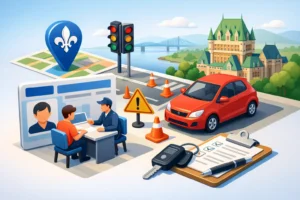
If you are trying to figure out how to get drivers license in Quebec, the process can feel more complicated than it should. There are age rules, mandatory training, waiting periods, knowledge testing, and a road test at the end. The good news is that the path is very manageable when you understand the order of the steps and give yourself enough time to build real confidence behind the wheel.
For most new drivers, the goal is a Class 5 license, which allows you to drive a passenger vehicle. Quebec uses a graduated licensing system, so you do not go straight to a full license on day one. You begin with a learner stage, move through structured training and supervised practice, then take the road test when you are eligible.
How to get drivers license in Quebec step by step
If you are a first-time driver, the usual starting point is enrolling in an SAAQ-approved driving course. In Quebec, this is not optional for new Class 5 drivers. The course combines theory and in-car training and is divided into phases, which means you build knowledge and driving skill progressively rather than trying to rush everything into a few weeks.
After starting the course and meeting the minimum age requirement, you can take the knowledge test for your learner’s license. Once you pass, you receive a learner’s license and can begin driving under the required supervision rules. You then continue through the rest of the program, complete the waiting period, and eventually book your road test. Passing that road test leads to your probationary license, and after the required time and safe driving record, you move to a full Class 5 license.
That is the broad outline, but the details matter. Missing a step or misunderstanding the timing can delay your progress.
Start with the eligibility rules
In Quebec, you must meet the minimum age requirement before applying as a new driver. Most teens begin the process at 16, but if you are under 18, parental consent is required. Adults can begin later, of course, and many do. Some are first-time drivers. Others are newcomers or people who put off licensing for years and now want a clear, structured path.
If you already hold a license from another province or country, your situation may be different. In some cases, an exchange or conversion process applies instead of the full beginner pathway. That depends on where your previous license was issued, how long you have held it, and whether supporting documents are accepted. If your background is not straightforward, it is worth confirming the exact SAAQ requirements before enrolling in a full beginner process you may not need.
The mandatory driving course
For new Class 5 drivers, Quebec requires an approved driving course. This is one of the biggest differences compared with places where private practice alone is enough. The course is designed to teach not only vehicle control but also judgment, hazard awareness, sharing the road, and defensive habits that matter in real traffic.
This step is where many students either gain confidence or lose momentum. A structured program helps because it breaks learning into manageable stages. Theory sessions explain the rules and decision-making. In-car lessons give you practical repetition in real conditions. A good school also helps you prepare for what often makes people nervous – lane changes, intersections, parking, busy city traffic, and test-day pressure.
For anxious beginners, this part should not be treated as a box to check. The quality of your instruction often affects how ready you feel months later when the road test approaches. That is why many learners prefer an established SAAQ-approved school with a long track record, especially if they want steady guidance rather than guesswork.
Getting your learner’s license
Once you have completed the required early stage of the course and become eligible for testing, you can take the knowledge test. This exam covers road signs, traffic laws, safe driving behavior, and situations you are expected to recognize before driving independently.
Studying matters here. Many students assume the written portion will be easy and get caught by questions that test judgment, not just memorization. You should be comfortable with right-of-way rules, speed limits, school zones, alcohol-related restrictions, following distance, and what different signs require you to do.
When you pass, you receive a learner’s license. At that point, you are allowed to drive, but only under learner conditions. That usually means being accompanied by a qualified supervising driver and following all restrictions attached to the permit. These rules are there for a reason. The learner stage is where you begin turning classroom knowledge into safe habits.
Practice time is not just about hours
A common mistake is treating practice as a race to the road test. In reality, the strongest preparation comes from varied, consistent driving over time. You need experience in residential streets, busier urban roads, intersections, parking situations, and different weather conditions if possible.
This is especially true in Quebec, where road conditions can change quickly with rain, snow, slush, and reduced visibility. A driver who feels comfortable on a quiet summer afternoon may feel very different in winter traffic or at night. The more complete your practice is, the less likely you are to panic when conditions are less than ideal.
It also helps to practice with purpose. One session can focus on steering and lane position. Another can focus on mirror checks, turns, and smooth stops. Another can be dedicated to parking and reversing. Improvement usually comes faster when each drive has a clear goal.
When you can take the road test
To move from a learner’s license toward the next stage, you must complete the required training and wait the required amount of time before taking the road test. The exact timeline matters. Even strong drivers cannot book early just because they feel ready.
By the time your road test is near, you should be able to drive safely without constant coaching. The examiner is not looking for perfection, but they are watching for consistent control, observation, judgment, and compliance with the rules. Small mistakes may be manageable. Repeated errors, unsafe decisions, poor scanning, or failure to follow instructions can lead to a failed test.
If you have had a long gap in training or feel rusty, refresher lessons can make a major difference. A short return to professional instruction often helps learners correct habits that family members or friends may not notice.
What happens after you pass
Passing the road test does not mean you instantly receive a full unrestricted Class 5 license. New drivers generally move to a probationary stage first. During that period, specific rules still apply, and safe driving remains essential.
After completing the probationary period and maintaining a satisfactory record, you can move on to a full license. This graduated approach is meant to reduce risk while new drivers gain independent experience.
That progression can feel slow when you are eager to drive on your own. Still, it gives you time to mature as a driver in a way that is safer for you and everyone around you.
Common issues that slow people down
The biggest delays usually come from poor planning, inconsistent training, or underestimating the exams. Some students postpone theory study and fail the knowledge test. Others do not practice enough between lessons and arrive at the road test without enough real-world experience.
There is also the confidence issue. Many capable learners freeze up because they associate the test with pressure rather than preparation. That is why test-focused coaching matters. The right instruction does more than teach mechanics. It helps reduce stress, correct weak spots, and make the road test feel familiar instead of intimidating.
Vehicle access can also become a problem near test day. If you do not have a suitable car or your vehicle is not ideal for the exam, arranging a road-test car in advance can remove one more source of stress.
How to make the process easier
The simplest way to make progress is to treat licensing as a step-by-step project, not a last-minute task. Choose an approved school, stay consistent with the course schedule, study seriously for the knowledge test, and practice regularly between lessons.
If you are nervous, say so early. A patient instructor can adjust the pace, focus on confidence-building, and help you work through the situations that feel hardest. That is often more effective than forcing yourself into traffic before you are mentally ready. For many learners in the Montreal area, working with an experienced school like Montreal City Motor League can provide that balance of structure, patience, and road-test preparation.
For newcomers and adult beginners, the same advice applies. Do not compare your timeline to anyone else’s. Some students progress quickly. Others need more repetitions before things feel natural. What matters is becoming a safe, confident driver, not just getting through the process as fast as possible.
Getting licensed in Quebec takes patience, but it is absolutely achievable when you follow the right order and give yourself room to learn properly. A calm, well-prepared driver usually performs better than a rushed one, and that mindset will serve you long after test day.